
By Richard Guerra
Assistant Criminal District Attorney in Bexar County
It’s been over a year since the Texas Court of Criminal Appeals (CCA) issued its plurality opinion on geofence warrants in Wells v. State, which affirmed Mr. Wells’s conviction. Wells subsequently petitioned the Supreme Court of the United States (SCOTUS) for certiorari, which was granted. In a two-sentence opinion, the Court vacated the judgment and remanded the case to the CCA for consideration in light of the Supreme Court’s decision in Chatrie v. United States.[1] How might the Supreme Court’s opinion in Chatrie affect Texas geofence warrants? Did the Supreme Court finally settle the privacy law frontier? Let’s evaluate Chatrie v. United States to find out.
Background
A man walked into a credit union and presented to the teller a note demanding $100,000. It was spring—about 4:50 p.m. Within the note were threats against the teller and the teller’s family. There was a warning that the man had “boys on the lookout outside.”[2] When the note failed to secure his demand, the man brandished a gun. He ordered everyone to the ground. He forced the bank manager to remove $195,000 from the safe and put it into his bag. Then he fled on foot.
The local police investigation determined that the robber approached the credit union from the corner of an adjacent church. Surveillance footage saw him talking on a cell phone. Nearly a month later, the case went cold.
The geofence warrant
The police applied to a local magistrate for a geofence warrant that was directed to Google. The warrant’s affidavit explained that Google’s data could lead to identifying the robber, his possible accomplices (recall that the robber was seen talking on a cell phone), or additional witnesses.
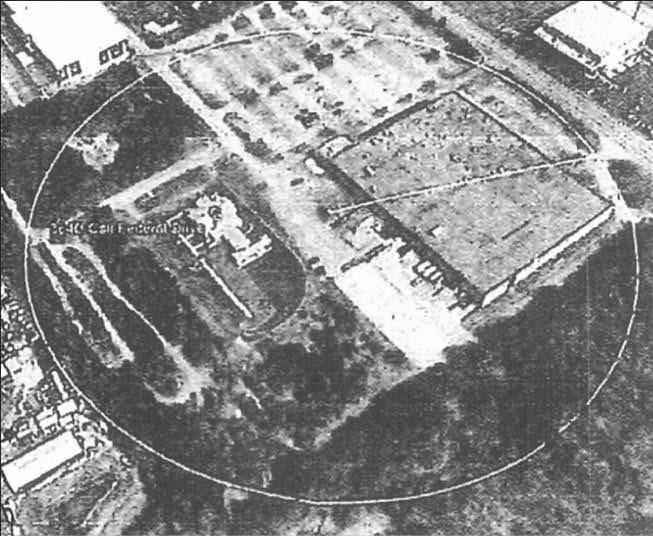
The warrant initially drew a geofence with a 150-meter radius and a diameter of 300 meters.[3] This coverage—longer than three football fields—included the bank and the nearby church. The total area of the geofence was 70,686 square meters, which was “about three and a half times the footprint of a New York City Block.”[4]
Three-step process
Google received its first geofence warrant in 2016. Other tech companies, including Apple, Lyft, Snapchat, and Uber, have received geofence warrants, but Google is the “most common recipient and the only one known to respond.”[5] Over time, Google worked with law enforcement to develop a three-step protocol for geofence warrants so that Google could provide the government with its users’ location data, which would typically include a device’s latitude and longitude coordinates with the corresponding timestamp, an estimate of each coordinate’s accuracy, and from what source Google collected this information via the user’s device—a wi-fi network, cell site, etc.[6]
The warrant application in this case described the three-step process.[7]
The first step sought anonymized location data for every device within the geofence from 4:20 p.m. to 5:20 p.m. on the day of the robbery. This timeframe was 30 minutes before and 30 minutes after the offense.[8] Here, Google gave police anonymized location data for 19 users within the geofence.
At the second step, the police would “attempt to narrow down the list [of devices] by reviewing the time stamped location coordinates for each and comparing that against known time and location information that is specific to the crime.”[9] For this narrowed list of anonymized users, Google would provide location information—regardless of whether it was inside or outside of the geofence—for an additional half-hour before and after step one’s timeframe, totaling two hours. Here, Google gave police extended location information data for nine users within and beyond the geofence.
At the third step, the police would “attempt to narrow down the list by comparing this additional information regarding travel and time against the known time and location information that is specific to this crime.”[10] Ultimately, Google identified three users (including their names and phone numbers) from the police’s third narrowed list of anonymized users. One of these three was Chatrie, whose location data showed him entering the geofence 10 minutes before the robbery and then heading toward a residential part of town immediately after leaving the bank.
Chatrie was charged with robbery and related firearms offenses. He moved to suppress the information Google had handed over to police. He argued that both the officers’ acquisition of his data through a Fourth Amendment search and the authorizing warrant for this search were invalid.[11] The district court denied Chatrie’s motion to suppress. The court ruled that the warrant violated the Fourth Amendment, but it admitted Chatrie’s location data under the good-faith exception. Although Texas Code of Criminal Procedure Art. 38.23(a) disallows illegally obtained evidence, the good-faith exception—found in Art. 38.23(b)—allows the admission of such evidence when obtained by an officer acting in good-faith reliance on a warrant issued by a neutral magistrate based on probable cause.[12]
The Fourth Circuit used different reasoning to uphold the location data’s admission. The circuit majority reasoned that no Fourth Amendment search had occurred, and consequently, the police did not need a warrant. The majority held that Chatrie didn’t have a reasonable expectation of privacy in two hours of Google location history data. After rehearing en banc, the Fourth Circuit affirmed in a single sentence.[13] Astonishingly, the majority split evenly—seven to seven—on whether a Fourth Amendment search had occurred and thus whether a warrant was required.[14]
Chatrie appealed to the United States Supreme Court.
As the judges saw it
The Supreme Court granted certiorari on the sole question of whether police conducted a Fourth Amendment search in obtaining Chatrie’s location data. Justice Kagan wrote the Court’s majority opinion; Chief Justice Roberts and Justices Sotomayor, Kavanaugh, and Jackson joined her. The majority held that the government conducts a Fourth Amendment search when it accesses historical cell phone location information.[15]
In its reasoning, the Court relied on the district court’s record of testimony regarding how Google collects, stores, and uses user location data. The Court initially observed—as it had done before in Riley v. California—the ubiquity of cell phones in modern life.[16] These phones contain a number of applications and services that collect and store detailed personal information that is used to assist users daily. Among this information is the device’s physical location. For example, cell phone apps use location data to help individuals navigate roads, check the weather forecast, and find nearby restaurants. The location data that these apps use is called “Location History.”
Google pulls Location History from multiple sources via a user’s cell phone: nearby wi-fi networks, Bluetooth beacons, cell sites, GPS information, and IPS address information, to create a time-stamped record of every place a cell phone has been within 20 meters. Google can also ascertain which floor of a building a device is on by tracking the device’s elevation.
Users are prompted to turn on Google Location History when a person creates a Google account. And again they are prompted each time a person sets up a Google app, which includes Google Assistant, Google Maps, Google Photos, etc. Google specifically warns Android users that their devices will not work correctly with Location History turned off. Over 500 million worldwide users have enabled Google Location History.
Once activated, Location History constantly runs in the background. It will continue to collect Location History by drawing on the aforementioned sources every two minutes or so. It will record the phone’s location even when the apps that utilize Location History are not in use. If the user deletes the app from which Location History was switched on, Google will still record the device’s location. If the user is not using the phone at all, Google will still record the device’s location. The only way to stop Google from recording Location History is for a user to affirmatively turn Location History off.[17]
At the time this case was argued, Google stored all Location History in the cloud, which means that the data was stored on remote servers rather than the user’s device. Google has since shifted to storing Location History on the user’s device. Google has stated that this decision prevents it from responding to geofence warrants based on Location History because—as of July 2025—it no longer has the ability to access that data.[18] Although this will affect Google’s future ability to respond to geofence warrants for Google Location History, Chatrie’s Location History was stored on Google’s servers. Even so, the Court pointed out that Google’s choice makes no substantial difference to the user. Indeed, whether the data is stored on a user’s phone or on Google’s servers makes no difference in how a user interacts with it when the user accesses previously travelled routes, daily commute updates, or location recommendations.
Carpenter v. United States
In Carpenter v. United States, the Court held that the government violated the Fourth Amendment when it accessed seven days’ worth of the defendant’s cell-site location information (CSLI).[19] At the forefront, the Court recognized that the similarities between CSLI’s and Location History’s relationship to privacy “practically leap[t] off the page.”[20] The Court described these similarities (see the chart below)—and noted an impactful difference:
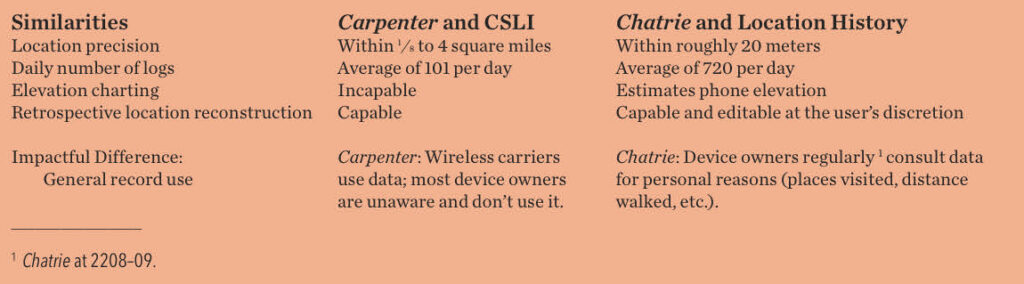
With these observations, the Court confirmed that Location History implicates privacy interests more than the CSLI at issue in Carpenter because it contains more specific, frequent, and intrusive data regarding the user’s daily personal life. Moreover, unlike CSLI, which is used by wireless carriers without most device owners’ awareness, device owners regularly access their own Location History—and can even edit it. According to the Court, this makes Location History more akin to a personal journal, which a user would reasonably view as his or her own. Consequently, the Court reached the same conclusion
that it had in Carpenter—users have a reasonable expectation of privacy in their Location Data.[21]
The Court next rejected the government’s argument that Chatrie had no reasonable expectation of privacy in a mere two hours of location history because this temporal duration was not significantly personally revealing.[22] The Court explained that the Fourth Amendment applied regardless of the quality or quantity of the information seized. The Court recalled that the total duration of the unconstitutional wiretap in Katz v. U.S. amounted to 18 minutes.
The Court next expressed concern for the all-encompassing nature of Location History data, which it distinguished from the more rudimentary technology (a beeper) that the police accessed in United States v. Knotts, in which the Court declared that “different constitutional principals” could apply if technology advanced to allow more sophisticated surveillance. Moreover, the Court pointed to the fact that the surveillance in Knotts was on public roads in which the defendant had no reasonable expectation of privacy.[23]
In analyzing whether the third-party doctrine should apply to Location History, the Court couldn’t ignore the similarities between this case and Carpenter. Prior SCOTUS caselaw had held that a bank depositor had no reasonable expectation of privacy in canceled checks and deposit slips that the depositor had voluntarily conveyed to the bank. Likewise, a telephone subscriber has no reasonable privacy expectation in dialed phone numbers as the subscriber voluntarily conveyed those numbers to the telephone company.[24] But the Court distinguished these prior cases because, like the CSLI in Carpenter, Location History information is “qualitatively different” from bank records and phone numbers.[25]
Location History is exhaustive in scope when compared to the limited information in telephone numbers and bank records. Additionally, a cell phone user does not voluntarily expose Location History information with the same meaningful understanding as these other types of data because sharing Location History “is the automatic price of conventional cell-phone usage, especially when cell phones are as pervasive and necessary to daily life.”[26] Moreover, Google does not notify users of Location History’s frequency, precision, and government accessibility.
The Government argued that opting into Location History is not indispensable because only one-third of Google accountholders had activated the service; thus, Location History is voluntarily activated by an affirmative act. Although the Court took issue with the reliability of this statistic, it ultimately didn’t matter to the Court’s voluntariness analysis. According to the Court, the Government’s argument misunderstood the nature of how cell phones are used. Sending emails, uploading photos, and adjusting calendar entries are all affirmative acts. Each act requires an optional add-on beyond the phone’s general operation. And each act shares private information with a third-party tech company. Divorcing all these activities from the act of turning on the phone, with only turning on the phone receiving Fourth Amendment protection, conflicts with the manner in which cell phones are used. An individual’s use of a device’s apps and services pervades everyday life more than the cell phone itself. The point of carrying a cell phone is to use it, apps and all.[27]
Ultimately, the Court held that “police officers invade a cell-phone user’s reasonable expectation of privacy when they access his Location History. It does not matter if the time period scrutinized was only two hours. Nor does it matter that the materials obtained were handed over by a third-party tech company. When the government ‘accesses historical cell phone’ location information—Location History as much as CSLI—it ‘conducts a search under the Fourth Amendment.’”[28]
The Court vacated the Court of Appeals’s judgment and remanded the case to the Fourth Circuit to consider the geofence warrant’s constitutionality—whether it established probable cause to support the search and whether the search’s scope (including its geographic and temporal limitations) was described with sufficient particularity.
Justice Jackson’s concurring opinion
Justice Jackson warned that—at bottom—the second and third stages of the geofence warrant process did not satisfy probable cause and did not describe the search’s scope with particularity. She reiterated dicta from the Court’s opinion that expressed concern the warrant offered little information regarding how the officers would narrow the list of users at these stages.[29] This information fit into a single sentence in the warrant: that the police would “attempt to narrow down the list by reviewing the time stamped location coordinates for each [device] and comparing that against the known time and location information that is specific to this crime.”[30] Justice Jackson found it problematic that the warrant’s second and third steps did not require a magistrate to review how the police would “attempt” to narrow the list. This lack of judicial oversight allowed the police too much discretion.[31]
Justice Gorsuch’s concurring opinion
Though he reached the same conclusion, Justice Gorsuch would have eschewed relying on Carpenter, Katz, and the third-party doctrine for his analysis. Quoting mostly from his own dissent in Carpenter, Justice Gorsuch opined that the Court wasn’t equipped to empirically assess what Americans think are reasonable privacy expectations. Like Justice Scalia did in U.S. v. Jones, he would apply property law to determine whether Chatrie’s privacy rights were invaded.
Justice Gorsuch reviewed the agreement between Google and Chatrie regarding Location History and determined that the agreement granted Chatrie the right to enjoy, manage, alter, dispose of, and exclude others from his Location History information. These rights granted Chatrie a strong claim that his Location History was personal property.[32] Additionally, Virginia’s Computer Crimes Act expressly describes “computer data” as a form of property. Other states, including Texas, have similar laws. As such, Justice Gorsuch suggested that the Fourth Amendment could protect Chatrie’s Location History as personal “effects.” He noted that the Fourth Amendment protects against searches performed by a private party if that private party acts as an agent of the State. Thus, the government conducted a search when it compelled Google to rummage through and turn over its data.[33]
Justice Alito’s dissenting opinion
Justice Alito would have relied on the third-party doctrine to hold that Chatrie could not challenge the geofence warrant under the Fourth Amendment.[34] He reached back to America’s first century of search and seizure law—which protected only the physical security of persons and property—for the proposition that document productions orders—to which he likened Google Location History—are not Fourth Amendment searches.[35]
He distinguished between the Google Location History files themselves and the information on spreadsheets Google provided to police, which summarized the historical facts about Chatrie’s location. He equated it to the difference between ownership of a newspaper article and ownership of the facts on which the article had reported.
According to Justice Alito, Carpenter was unique—not meant to be expanded as the majority did here. Moreover, Carpenter had a greater privacy interest than Chatrie because Carpenter’s phone was the only phone tracked, it tracked him into private residences, and he did not voluntarily share his CSLI with his cellular carrier. Moreover, Location History is not essential to a cell phone’s functionality. Thus, under the third- party doctrine, Chatrie assumed the risk that Google might share his information with the police, among others.[36]
Justice Barrett’s dissenting opinion
Justice Barrett would have held that Chatrie had no reasonable expectation of privacy in data regarding his public moments that he voluntarily disclosed to Google.
The takeaway
A year ago in this journal, I recommended that prosecutors should presume users have a reasonable expectation of privacy in Google’s Location History.[37] This still holds true under Chatrie. However, prosecutors now have smidgens of certainty: 1) accessing Location History is a Fourth Amendment search; 2) a geofence warrant doesn’t have a two-hour constitutional grace period; and 3) the third-party doctrine does not apply to Location History.
Going forward, law enforcement should obtain a warrant to access geofenced Location History. The Court did mention the potential for warrantless access to Location History by way of exceptions to the warrant requirement (the Court specifically identified the exigent circumstances exception).[38] However, due to a dearth of caselaw on this subject, prosecutors and police should consider relying on exigent circumstances only in situations in which there is absolutely, sincerely, no other way.
Now that courts have certainty regarding whether accessing Location Data is a search, they will shift to analyzing the contents of geofence warrant affidavits. Recall that in Wells v. State, CCA Judge Yeary noted that probable cause exists if, under the totality of the circumstances, there is “at least a ‘fair probability’ or ‘substantial chance’ (it need not be ‘more likely than not’) that evidence of an offense will be found at the location that law enforcement seeks to search.”[39] This language remains useful for prosecutors to lean on when arguing the sufficiency of a geofence warrant affidavit to trial courts. Indeed, the Chatrie Court referred to the requisite “fair probability” when discussing (in dicta) the potential issues that the geofence warrant’s affidavit might raise. The appropriate scope of a search must be “carefully tailored to its justifications.” Law enforcement should work with prosecutors to ensure that the warrant’s affidavit supports its scope and duration with articulatable information.
Justice Jackson took issue with the warrant affidavit’s lack of particularity in its second and third steps. The warrant required only that officers “attempt” to narrow the list of anonymous users that they received through step one to obtain the second and then the third data sets. This is likely problematic because a promised “attempt” to do something offers no assurance that it will be done. Geofence warrant affidavits should offer detailed explanations of precisely how they will utilize investigative information to narrow the step one’s anonymized list and then again in step two.
With the problem of specificity in mind, my (likely unpopular) suggestion is to have a magistrate review and approve each of the geofence warrant’s three steps. This would functionally break the single geofence warrant into a series of three individual geofence warrants. This way the information obtained from step one can be applied to the analysis in step two, and then the information obtained from step two can be applied to the analysis in step three. This removes the potential problem of leaving the officers who execute the warrant with too much discretion. It would also likely assist prosecutors in arguing—should the need arise—good faith reliance. I expect that this practice could ultimately become mandatory if geofence warrants continue to be used to obtain data from other cloud-based digital service providers. Virtually every American uses cloud-based services that—like Google’s Location History—can track or tag their location, including email, cloud storage, search engines, navigation apps, and social media.[40]
Recall that the warrant affidavit in Wells relied on the ubiquity of cell phones to give the magistrate a substantial basis to conclude there was a fair probability that one of the perpetrators possessed a device with Google apps installed. Although relying on this general knowledge is useful, a warrant affidavit should include—if possible—the investigator’s specific reasons for believing a cell phone was present and/or used during the commission of a crime.[41] This could include surveillance footage, witness interviews, or more. If there is extra information, use it. Don’t just rely on the fact that cell phones are everywhere. Look for facts that point to a suspect using a specific application that stores location data.
It is probably unwise for law enforcement to draw a geofence warrant as large as the one in Chatrie, which was larger than three football fields in step one and then more than doubled in size in step two. In step two, the Chatrie geofence included—in addition to the bank and adjacent church—a Ruby Tuesday restaurant, a Hampton Inn hotel, several units of a nearby apartment complex, a storage business, a senior living facility, two busy streets, and what appeared to be several residences.[42] To contrast, the geofenced area in Wells included a single residence and part of the adjacent church from where the suspects approached. Similarly, the duration of the geofence warrant in Chatrie was double the duration of the Wells warrant. This is not to say that a huge geofenced area over an extended period of time will always fail scrutiny. But the drafter of the warrant affidavit should have darn good (specific) reasons for its size and scope.
We now have some clarity on geofence warrants, but the process of taming this frontier is just beginning. Chatrie offers us a saddle, but the horses are still wild and the horizon is still expanding.
[1] Wells v. State, No. 25-484, 2026 WL 1871296, at *1 (U.S. June 30, 2026).
[2] Chatrie v. United States, 146 S. Ct. 2193, 2202 (2026).
[3] Chatrie, 146 S. Ct. at 2202; United States v. Chatrie, 590 F. Supp. 3d 901, 918 (E.D. Va. 2022).
[4] Chatrie, 590 F. Supp. 3d at 919.
[5] Chatrie, 590 F. Supp. 3d at 919.
[6] Chatrie, 146 S. Ct. at 2021 n.3.
[7] Chatrie, 146 S. Ct. at 2022.
[8] Chatrie, 146 S. Ct. at 2202.
[9] Id.
[10] Id. at 2203.
[11] Id.
[12] Tex. Code. Crim. Proc. Art. 38.23.
[13] “PER CURIAM: The judgment of the district court is AFFIRMED.” United States v. Chatrie, 136 F.4th 100 (4th Cir. 2025), cert. granted in part, 223 L. Ed. 2d 553 (Jan. 16, 2026) and vacated and remanded, 146 S. Ct. 2193 (2026).
[14] Chatrie, 146 S. Ct. at 2203.
[15] Chatrie, 146 S. Ct. at 2215 (“We hold that police officers invade a cell-phone user’s reasonable expectation of privacy when they access his Location History. It does not matter if the time period scrutinized was only two hours. Nor does it matter that the materials obtained were handed over by a third-party tech company. When the government ‘accesses historical cell phone’ location information—Location History as much as CSLI [cell-site location information]—it “conducts a search under the Fourth Amendment.”).
[16] Id. at 2200 (“Today, more than nine in 10 Americans own a smartphone”).
[17] Id. at 2200–01.
[18] Brief for Amicus Curiae Google LLC in Support of Neither Party at *2, *10, Chatrie v. United States, 146 S. Ct. 2193 (2026) (No. 25-112) 2026 WL 624354.
[19] Carpenter v. United States, 585 U.S. 296, 310 (2018).
[20] Chatrie, 146 S. Ct. at 2207–08
[21] Id.
[22] Id. at 2209–10. (“[W]e have never understood Fourth Amendment protections as kicking in only once an intrusion ‘goes too far’”).
[23] Id. at 2210–11.
[24] Id. at 2212 (citing United States v. Miller, 425 U.S. 435 (1976); Smith v. Maryland, 442 U.S. 7350 (1979).
[25] Id.
[26] Id.
[27] Id. at 2214.
[28] Id. at 2215 (quoting Carpenter v. United States, 585 U.S. 296, 310).
[29] Id. at 2217.
[30] Id. at 2216.
[31] Id. at 2218.
[32] Id. at 2218–21.
[33] Id. at 2222.
[34] Part I of Justice Alito’s dissenting opinion describes why he believed that the majority’s opinion was a performative advisory opinion. Id. at 2222–26. Although interesting to study, it is likely not of significant use to trial prosecutors. As such, it is only mentioned in this footnote.
[35] Id. at 2226–27.
[36] Id. at 2229.
[37] www.tdcaa.com/journal/geofence-warrants-and-the-frontier-of-fourth-amendment-law.
[38] Id. at 2215 n.11.
[39] Wells v. State, 714 S.W.3d 614, 623 (Tex. Crim. App. 2025), reh’g denied, 721 S.W.3d 260 (Tex. Crim. App. 2025), cert. granted, judgment vacated, No. 25-484, 2026 WL 1871296 (U.S. June 30, 2026) (quoting Illinois v. Gates, 462 U.S. 213, 238, 243 n.13 (1983)).
[40] See Brief for Amicus Curiae Google LLC in Support of Neither Party at *36, Chatrie v. United States, 146 S. Ct. 2193 (2026) (No. 25-112) 2026 WL 624354.
[41] Somewhat similar reasoning to cell phone searches discussed in State v. Baldwin, 664 S.W.3d 122 (Tex. Crim. App. 2022) (an affidavit for a search of a cell phone must include “other facts and reasonable inferences that establish a nexus between the device and the offense” to support a finding of probable cause; “boilerplate” language about criminals commonly using cell phones when committing crimes insufficient to establish probable cause in an affidavit to search a suspect’s cell phone).
[42] Chatrie, 590 F. Supp. 3d 901, 922-23.