
By Kevin McCary
Assistant County Attorney in El Paso County
It’s the 2025 World Series. It’s the bottom of the ninth, score tied at four runs apiece, and the bases are loaded for the home-team Blue Jays. Pinch-runner Isiah Kiner-Falefa is tethered to third base with a short lead. And then his teammate Daulton Varsho made contact with the ball, sending a 76.9-mph two-hopper to Dodgers second baseman Miguel Rojas, who stumbled before throwing it home to catcher Will Smith. In the scramble, Smith’s foot lifted off the plate before he finally pushed it back down.[1] Kiner-Falefa was called out.[2] But was he?
Major League Baseball (MLB) replay umpires reviewed the play to determine if “clear and convincing evidence” existed to change the call, confirm it, or let it stand due to insufficient evidence.[3] In baseball, factual calls are subject to a “clear and convincing”[4] standard of review—did catcher Smith’s foot timely contact the plate to force an out?[5] (For a changed call, replay officials have sole discretion to place runners where they would have been had the call been correct.[6]) But unlike an appellate case, a question of law (the baseball rules) is not appealable at all.[7] So the call (the foot’s timing) was reviewed, but the ruling (the application of the “Force-Play” rule) was not.[8]
In Texas civil appeals, the “call” and the “ruling” lack such categorical finality. On appeal, they fall into distinct categories of legal and factual sufficiency.[9] And unlike the merged standards in Texas criminal jurisprudence,[10] civil practitioners must navigate a dual-track system where the standard of review dictates the deference an appellate court owes the litigants and the trial court—which standard applies depends on who had the burden of proof, and the burden of proof will depend on which phase of trial you’re in (summary judgment, directed verdict, etc.). These standards of review are confusing even to seasoned lawyers and may confound criminal practitioners who come across a civil appeal. This article is my stab at clarifying things for practitioners in a few pages.
The hypothetical
Imagine an alternate universe where Isiah Kiner-Falefa’s “out” call could not be reviewed by video replay but instead by a trial and then by appeal in Texas courts. Because the administrative ruling (the umpire’s call) went against the Blue Jays, assume the Toronto team has the burden of proof at trial. The Blue Jays might hire an expert—perhaps a retired Blue Jay. The expert might say, “I ran those bases many times, and I know how big a lead you need to beat a bobbled two-hopper thrown home, and Kiner-Falefa had just the right lead. He must have been safe.” A Toronto jury might buy that testimony and reverse the call, even without empirical analysis.
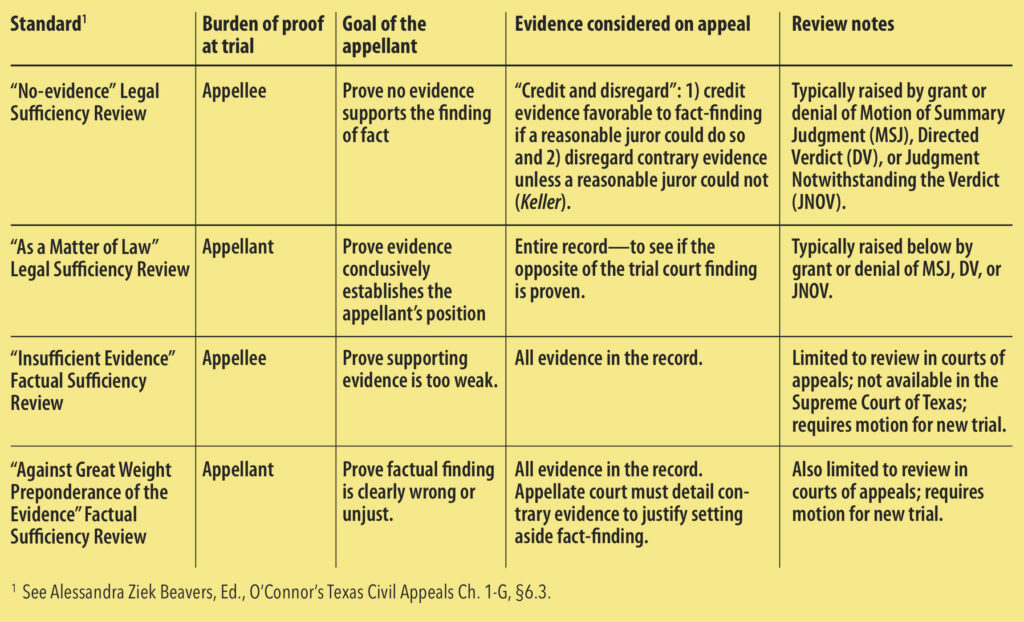
The Los Angeles Dodgers, however, would challenge the sufficiency of that evidence on appeal. An appellate court would then evaluate LA’s challenge based on who had the burden of proof at trial. The appeal would track one these four scenarios (See the chart, below, for an at-a-glance breakdown of what standard applies when):
Legal sufficiency reviews
If the appellee (Blue Jays) had the burden of proof at trial: The “No-Evidence” Legal Sufficiency Review applies. Under the City of Keller[11] “credit and disregard” standard, the court would look for any evidence supporting the trial court’s finding that Smith’s foot was late.
And what of the appellee’s expert? His testimony likely fails here. The Texas Supreme Court has held that a qualified expert’s “bare conclusions” do not support a legal finding.[12] Reversal in the Dodgers’ favor seems likely.
If the appellant (Dodgers) had the burden: “As a Matter of Law” Legal Sufficiency Review applies. Conversely, if the Dodgers (the appellant) had the burden (e.g., on an affirmative defense), the court of appeals would conduct an “as a matter of law” review.[13] In general, this standard gives deference to the fact finding below: The court of appeals must 1) give credit to evidence favorable to the adverse finding if a reasonable finder of fact could, and 2) must disregard contrary evidence unless a reasonable fact finder could not.[14] In other words, the Dodgers would have to demonstrate the evidence established all vital facts (foot on plate, throw and catch were on time) as a matter of law.
Factual sufficiency reviews
Exclusive to intermediate courts of appeals, this review considers all evidence to determine if the finding is “manifestly unjust.”[15] It is preserved by a motion for new trial in the trial court.
If the appellee (Blue Jays) had the burden: The “Insufficient Evidence” Factual Sufficiency Review applies. Alternatively, the Dodgers might argue the finding was “factually insufficient.”[16] Here, the appellate court would consider all evidence presented by both teams, but the court would set aside the trial court verdict only if it was “clearly wrong and unjust.”[17]
If the appellant (Dodgers) had the burden: “Against Great Weight Preponderance of the Evidence” Factual Sufficiency Review applies. This standard applies where the appellant had the burden of proof at trial, so it is not applicable here. However, if it were, the court of appeals would consider and weigh all of the evidence, and it would set aside the verdict only if the evidence were so weak or the finding so against the great weight and preponderance of the evidence as to be clearly wrong and unjust.[18] Caselaw also requires the court of appeals to “detail the evidence relevant to the issue [and] state in what regard the contrary evidence greatly outweighs the evidence in support of the verdict.”[19]
Conclusion
Umpires make snap decisions that the world will watch in seconds or milliseconds—and then re-watch for years. The video replay era has sharpened those decisions and provided confidence in outcomes. But video replay provides evidence not often available when complex trial court findings are questioned on appeal. Perhaps for this reason, fact-finding is subject to complex standards of review that trial and appellate practitioners would be wise to keep in mind—along with the burden of proof—at all stages of litigation.
As for the 2025 World Series? A March 2026 MLB report concluded that catcher Will Smith’s foot was on the plate when he caught the ball, as well as before he lifted it off the plate and put it back.[20] The play was never as close as it seemed; Kiner-Falefa was out by about 3 feet, the baseball equivalent of a country mile. Affirmed.
[1] You can see the play at: Jackson Krueger Sports, The Most Insane World Series Game 7 You’ll Ever See, YouTube (Nov. 1, 2025 at 1:24), https://tinyurl.com/ 2f68vh28; Boxer Shorts Media Podcast with Joe Ward, Video Analysis: Bluejays Isiah Kiner-Falefa Out at Home Plate–9th Inning, Game 7, MLA [sic] World Series, YouTube (Nov. 3, 2025 at 0:00:02), https://tinyurl.com/ 3a98jzct.
[2] Ben Walker, MLB report settles World Series Game 7 plate drama: IKF was out by feet, not inches, ABCNews (March 10, 2026 3:09 PM), https://tinyurl.com/ 2s368b89; Kiner-Falefa in hindsight wishes he had taken bigger lead in World Series Game 7, APnews.com (Feb. 10, 2026, 5:16 PM MDT), https://tinyurl.com/ 29vyfhcu.
[3] MLB.com, Replay Review (no date), https://tinyurl .com/3aeexejz. For an explanation as to how MLB processes video challenges, see, MLB, MLB Replay Room EXCLUSIVE look!, YouTube (July 17, 2025), https://tinyurl.com/3v7av6sy.
[4] Baseball’s “clear and convincing standard” in a replay appeal should not be confused with the “clear and convincing standard” used in some Texas trials.
[5] Replay Review, supra n.3.
[6] Id.
[7] See id.
[8] See, MLB.com, Force Play, Definition https://tinyurl.com/5bjd7naw.
[9] Other standards of review, e.g. “de novo” and “abuse of discretion” are beyond the scope of this article.
[10] See Brooks v. State, 323 S.W.3d 893 (Tex. Crim. App. 2010).
[11] Graham Cent. Station, Inc. v. Pena, 442 S.W.3d 261, 263 (Tex. 2014); City of Keller v. Wilson, 168 S.W.3d 802, 810-812 (Tex. 2005) (noting that a “no-evidence” point is sustained only if evidence of a vital fact is completely absent, legally barred, a mere scintilla, or conclusively establishes the opposite).
[12] Nat. Gas Pipeline Co. of Am. v. Justiss, 397 S.W.3d 150, 156. (Tex. 2012); citing Coastal Transp. Co. v. Crown Cent. Petroleum Corp., 136 S.W.3d 227, 231–32 (Tex. 2004).
[13] McKeehan v. Wilmington Sav. Fund Soc’y, FSB, 554 S.W.3d 692, 698 (Tex. App.—Houston [1st Dist.] 2018, no pet.).
[14] Syed v. Masihuddin, 521 S.W.3d 840, n.4 (Tex. App.—Houston [1st Dist.] 2017, no pet.) (citing Keller, supra n. 12 at 827).
[15] Playboy Enterprises, Inc. v. Editorial Caballero, S.A. de C.V., 202 S.W.3d 250 (Tex. App.—Corpus Christi–Edinburg 2006, pet. denied).
[16] Keller, supra n.11, 168 S.W.3d at 826.
[17] Playboy Enterprises, Inc., supra n. 16, at 264.
[18] Dow Chem. Co. v. Francis, 46 S.W.3d 237, 242 (Tex. 2001).
[19] Id. (cleaned up).
[20] See Walker, supra n.1.