
Texas finally decided to participate in winter. The chill you felt was not just the weather, but the realization that we are less than one year away from the 90th Legislative Session. We are here to help you prepare for that storm as we track elections, interim charges, and the whispers in the political winds. Session is coming.
Prosecutor Elections
We are the only source for all the primary elections for County and District Attorneys across Texas. Please see our lineup and let us know if we missed anyone or anything. With the March 3rd primary just weeks away, now is the time to verify the candidates in your area.
Judicial Races
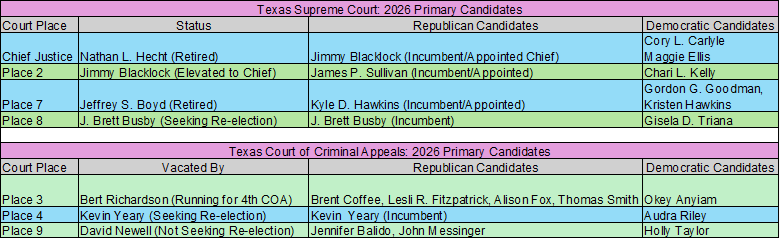
The 2026 judicial cycle is a domino effect triggered by Chief Justice Nathan Hecht’s retirement from the Supreme Court and the open seats at the Court of Criminal Appeals in Place 3 and Place 9. The Republican primary for Place 3 is currently the most crowded judicial race on the statewide ballot. Justice Bert Richardson’s decision to run for the Fourth Court of Appeals is a rare downward move for a sitting statewide judge. Please see the graph below for a list of the candidates.
Attorney General Race
The Republican primary for Attorney General has emerged as a fundamental debate over the scope of the office. Recent polling from the University of Houston and Pulse Decision Science shows Chip Roy holding a commanding lead, consistently polling at 40%—nearly triple that of his nearest challengers. With the March 3rd primary approaching, the GOP candidates all have opinions on how their OAG will work with—or against—local prosecutors:
- Chip Roy: “I will pursue greater prosecutorial authority to enforce state law when failed district attorneys refuse to do their jobs. Texas law must and will be enforced in every county.”
- Mayes Middleton: Middleton has said he wants to see district attorneys removed from office if they do not fully prosecute certain crimes and supports a statewide prosecutor model for the OAG.
- Aaron Reitz: “When radical prosecutors in blue cities and counties openly refuse to enforce state law, they create lawless zones that endanger public safety and undermine democracy itself. Texas cannot allow a patchwork justice system where the law applies in red counties but not blue ones.”
- Joan Huffman: “I strongly support granting the attorney general broader independent criminal prosecutorial authority to address cases where soft-on-crime prosecutors in major cities have declined to enforce entire categories of crimes or disregarded state laws they oppose.”
Meanwhile, the Democratic candidates for OAG are taking more of a “local control” approach to the issue of prosecution. Who says politics never changes?
Interim Charges: The Blueprint for 2027
Do you have an idea for a new law? Now is the time to meet with your local elected representative or senator. The Texas Legislature uses the interim to hold committee meetings to discuss interim charges, the specific issues leadership wants studied before the gavel drops in January. These charges serve as the outline for the bills that they will file, debate, and maybe even pass. The House members have until February 9th to submit their requests for interim charges to Speaker Dustin Burrows. While Lt. Governor Dan Patrick has not yet announced the formal deadline for senators, their timeline is likely to be similar, so this is the optimal window to reach out to your local senator with ideas. Once the session begins, it is often too late to introduce a brand-new concept. If you want a seat at the table, make a reservation now.
SB 9: Public Safety Report System
As of January 1, 2026, the Office of Court Administration (OCA), on request by a prosecutor, shall provide access to the PSRS (Public Safety Report System) for the purpose of allowing the attorney to access a bail form submitted to the OCA. OCA asked that we distribute the following information regarding SB 9:
- The OCA is hosting a prosecutor-focused webinar addressing Senate Bill 9 statutory updates and related operational processes impacting prosecutor offices, including PSRS access, Pretrial Intervention (PTI) conditions, and the designee structure for mandatory electronic notifications.
- If individuals are unable to attend, webinar recordings, job aids, and prosecutor-specific resources are available on OCA’s Prosecutor Bail & Pretrial webpage: https://www.txcourts.gov/bail/prosecutor-information.
Protective Orders
The 89th Legislature passed HB 2596 that qualifies victims of a burglary of a habitation for a protective order and SB 2196 which increases a magistrate’s order for an emergency protection to a minimum of 61 days and a maximum of 121 days. This prompted OCA to update several of its protective order forms, including Final Order, Temporary Ex Parte Order, and the Application. Please see their link to download the updated forms: https://www.txcourts.gov/forms/standardized-protective-order-forms/
Consumable hemp
Marijuana. Cannabis. Hemp. CBD. THC. THCA. Delta-9, delta-8, delta-10 … yeah, you get it. A lot of figurative ink has been spilled over the past few months talking about issues related to “consumable hemp.” But where do things stand on that front now? Here’s an overview from our perch in Austin.
After vetoes and special sessions and such, the Texas legislature didn’t do anything in 2025 that would change state laws governing the criminal enforcement of consumable hemp, with one exception we identified in last year’s Legislative Update. That was SB 2024 by Perry (R-Lubbock), which expanded the crime for selling certain types of e-cigarettes (read: vapes) to include those that contain any amount of a cannabinoid (or other newly banned substances under that amended law). But aside from that Class A misdemeanor for selling or marketing such devices, not much changed on the criminal enforcement front.
(We still temporarily stop here and say: If you want the short answer, that’s it in a nutshell and you can stop reading. But if you continue to get asked about this topic back in your jurisdictions, keep going, because there has been a lot of smoke [pun intended], even if there hasn’t been much heat. Moving on …)
In Washington, part of the congressional compromise back in November to keep the federal government open included a prospective change to the federal definition of hemp from the 2018 Farm Bill (which is mirrored in Texas law) that will ban “intoxicating hemp products.” Scheduled to take effect in November 2026, this change means most consumable hemp products will be illegal at the federal level. However, that prospective change could be further altered or repealed altogether between now and then, and it would not impact state law, which is our focus.
The lack of statutory change in Texas does not mean things are static, though. Back in September, Gov. Greg Abbott ordered the Texas Department of State Health Services (DSHS) and the Texas Alcoholic Beverage Commission (TABC) to ban the sale of consumable hemp products to those under 21 years old. That triggered the adoption of certain emergency rules by those agencies, followed by a more deliberative administrative rulemaking process.
A summary of what TABC now enforces for its license or permit holders is available on TABC’s Consumable Hemp Regulations webpage. The regulations are similar to how TABC regulates the sale of alcohol to minors, but only from the seller’s side. For instance, there is no “minor in possession (MIP)” Class C equivalent for minors caught with consumable hemp because criminal prosecution must be based on a law, and these are only agency rules. TABC is also going to partner with DSHS to help that agency enforce new regulations of consumable hemp, but the latter agency is still in the middle of its rulemaking process.
DSHS proposed more wide-ranging regulations that were published in the Texas Register (Vol. 50, No. 52) on December 26, 2025. (A PDF of those proposed rules can be read here in case you didn’t get a copy in your Christmas stocking.) The agency also held a public hearing earlier this month on those proposals. Once DSHS goes through all the public comments it received, prepares answers for them, and makes any changes in response to them, the final rules will be published in a future Texas Register and take effect. But again, agency rulemaking cannot change the law, so these regulations will be administrative regulations enforceable by the agencies, not crimes enforceable by prosecutors. For more information, see DSHS’s Consumable Hemp Program webpage.
But don’t be lulled into thinking the adoption of final rules will be the end of this saga, because after rulemaking comes the civil lawsuits challenging those rules. For example, the Texas Supreme Court heard arguments earlier this month in a case challenging DSHS’s attempt to adopt rules banning delta-8 THC products back in 2021. A definitive answer from the court on that question should be forthcoming later this year, but as that five-year course of litigation shows, the agency rules on consumable hemp that will be finalized later this year could also be years away from taking full effect if they are challenged in court. That means the Texas Legislature will also get their say on this topic again next year. And round and round we go …
SB 8: Mandatory 287(g) Participation
As of January 1, 2026, Texas sheriffs are required to enter into an immigration law enforcement agreement to authorize the sheriff and officers, employees, and, as applicable, contractors of the sheriff’s department to enforce federal immigration law. Sheriffs may apply for grants from the Comptroller’s office to pay for costs associated with the agreement including salaries, training, equipment, and jail costs for housing illegal immigrants. The Attorney General is empowered to bring a suit against Sheriffs that do not enter into these agreements.
Quotes
“The Democrats will vote for him because they want to get him the hell out. And the Republicans will vote for him because they want to get him the hell out, too.”
—President Trump discussing nominating U.S. Senator Ted Cruz (R) to the United States Supreme Court.
“My answer’s not just no, it’s hell no. A principled federal judge stays out of political fights and stays out of policy fights. I want to be right in the middle of them.”
—U.S. Senator Ted Cruz (R) responding to the possibility of being nominated to the US Supreme Court.
“I spent 18 years there. It was a good 18 years; I worked my ass off. My generation has screwed this country up enough, quite frankly. It’s time for a new generation to come in and fill some of these seats.”
—Former U.S. Senator Jon Tester (D–Montana) discussing why he will not run for U.S. Senate again.
“Whoever goes to the United States Senate is going to have to be ready for real war. … I am here to tell you that it is life or death.”
—Congresswoman Jasmine Crockett explaining why she is the better candidate for U.S. Senate at a recent debate with Representative James Talarico (D-Austin).
“Texas DAs should be focused on prosecuting crimes in Texas, not joining committees seeking to undermine the rule of law.”
—Governor Greg Abbott responding to two Texas district attorneys joining the FAFO (Fight Against Federal Overreach) Project, which is a coalition of prosecutors across the country vowing to hold federal agents accountable if they break the law.